

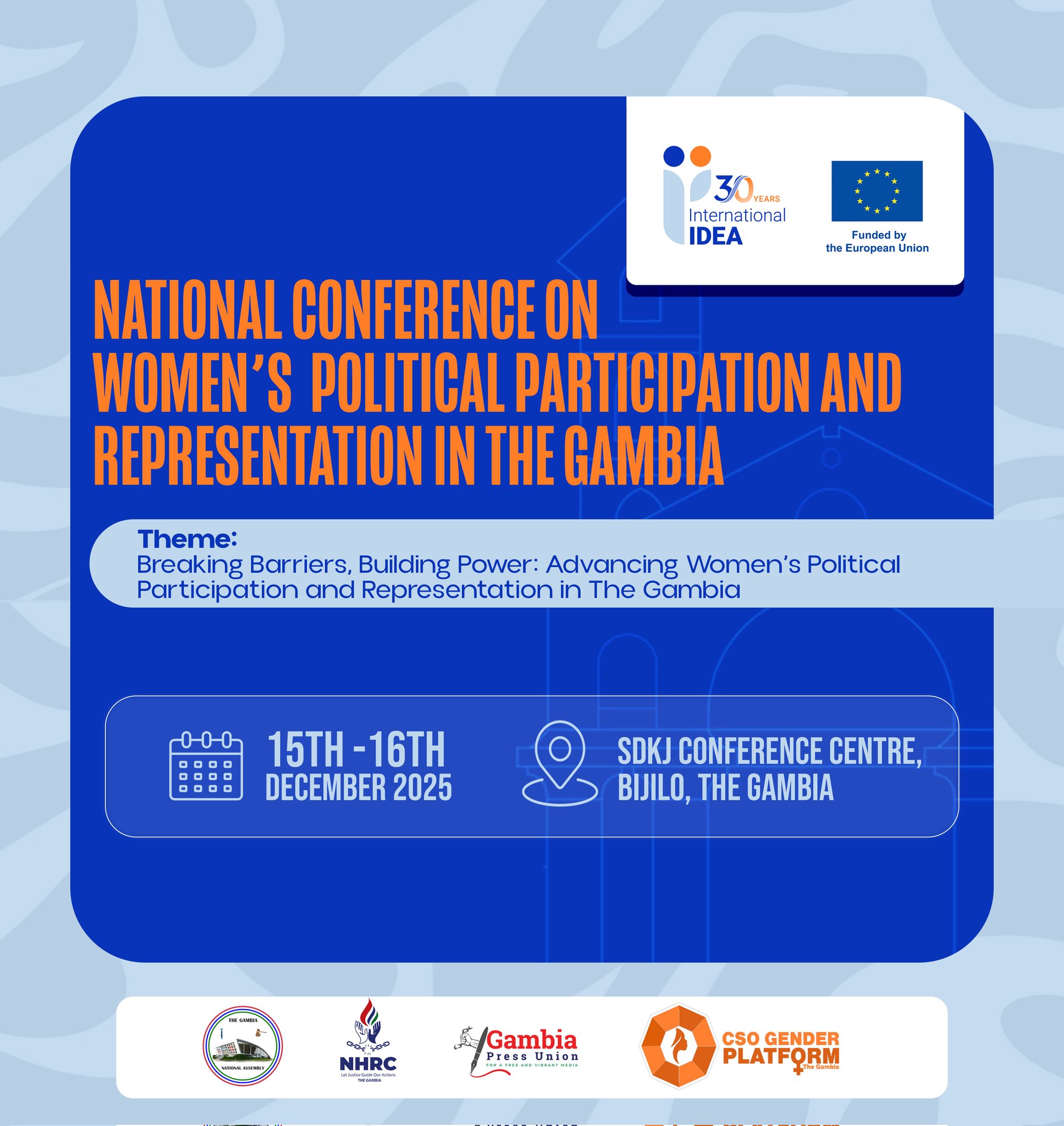
National Conference on Women’s Political Participation and Representation in The Gambia
Building Action and Accountability – 16 December 2025
08:00 – 09:00 – Arrival and Registration
09:00 – 10:30 – Panel Session 1: High Level Political Parties’ Panel – driving change!
Political parties determine candidate selection, financing, leadership opportunities, and internal democracy. All of which affect women’s representation. This panel brings party leaders together to discuss commitments, challenges, and policy shifts needed to promote gender balance. Emphasis will be placed on practical steps, including quotas, financial support, leadership pipelines, and eliminating discriminatory practices.
Q: Given the central role of political parties in shaping who gets selected, supported, and elected, what concrete commitments can parties adopt such as financing thresholds, quota compliance, leadership pipelines, or disciplinary measures against discrimination to meaningfully increase women’s representation and influence within party structures and national politics?
NB: Panellists for this session were selected based on parties currently represented in the National Assembly and those that were presidential candidates in the 2021 elections – those in coalition are represented by coalition lead)
Moderator: Ms. Fatou Jagne Senghore – Founder, Center for Women’s Rights and Leadership (CWRL)
Panellists:
Hon. Essa Faal – Party Leader, APP Sobeyaa
Hon. Mama Kandeh – Party Leader, GDC
H. E. Adama Barrow – Party Leader, NPP
Hon. Lamin J. Darbo – Party Leader, NUP
Hon. Halifa Sallah – Party Leader, PDOIS
H. E. Ousainu Darboe – Party Leader, UDP
Discussions with Participants
10:30 – 11:00 – Tea Break
11:00 – 12:30 – Breakout Sessions: Participants divide into three Thematic Working Groups to explore challenges and solutions
Thematic 1: Tackling hate speech and violence against women in the digital era
Online harassment has become one of the fastest-growing barriers to women’s political participation worldwide and in The Gambia. Female politicians, journalists, and activists face coordinated trolling, doxxing, sexualised threats, and deep-fake imagery, often intended to force them out of public life. Young women aspirants are particularly vulnerable. This panel examines patterns of online abuse, legal protections, reporting mechanisms, digital literacy, and collective strategies to ensure safer digital spaces for women in politics.
Q: With online platforms becoming both essential political tools and major sites of gendered harassment and hate speech, what comprehensive framework should be put in place to effectively prevent and respond to technology-facilitated violence against women in politics in The Gambia?
Moderator: Ms. Isatou Keita – President, Gambia Press Union
Panellists:
Ms. Ya Amie Touray – Commissioner, Information Commission
Dr. Njogu Bah – Director General, PURA
Mr. Basiru Bah – Ag. Director, Legal and Investigation – National Human Rights Commission
Ms. Mariama Barry – Deputy Superintendent of Police, Gambia Police Force
Discussions with Participants
Thematic 2: Women’s Capacity Building, Grassroots Mobilization and Campaign Financing
Women’s political participation is influenced by access to skills, networks, and financial resources. Capacity-building programs, mentorship, and grassroots mobilization significantly improve women’s political readiness, yet financing remains a major barrier. This session explores strategies to strengthen leadership skills, enhance community support, and improve access to campaign funding for women aspirants.
Q: What integrated strategy would most effectively strengthen the pipeline of women candidates across local and national levels, and how can civil society, development partners, and political parties collaborate to sustain these efforts?
Moderator: Mrs. Tabu Njie Sarr – Coordinator, CSO Gender Platform
Panellists:
Hon. Fatou Kinteh – Minister for Gender, Children and Social Welfare
Mayor Rohey Malick Lowe – Lord Mayor, Banjul City Council & President, REFELA Africa
Ms. Yadi Njie Eribo – Director, FAWEGAM and Chair, TANGO
Ms. Salama Njie – National Network Coordinator, WANEP-The Gambia
Discussions with Participants
Thematic 3: The Role of Youth and Male Allies in Promoting Women’s Political Participation
Youth and male allies are key drivers of cultural transformation and inclusive politics. Young people can challenge stereotypes, promote accountability, and support women’s leadership through activism, digital advocacy, and party engagement. This session explores how youth and allies can strengthen movements for women’s political advancement.
Q: How can youth and male allies be mobilized as transformative actors in shifting political and cultural norms that restrict women’s participation, and what specific platforms, partnerships, and advocacy strategies can empower them to actively promote gender-inclusive political spaces?
Moderator: Hon. Jabou Sisawo – Speaker, National Youth Parliament
Panellists:
Hon. Gibbi Mballow – National Assembly Member, Lower Fulladu West
Mr. Lamin Camara – Assistant Country Representative, UNFPA
Ms. Satang Dumbuya – Chairperson, National Youth Council
Mr. Modou Lamin Davies – Founder, Men 4 Equality
Discussions with Participants
12:30 – 14:00- Panel Session 2: Exchanges with Female Heads of Mission in The Gambia
Several countries have dramatically increased women’s representation through quotas, public funding tied to gender equality, and strong enforcement. Female diplomats bring global insights into successful approaches for enhancing women’s political representation. This panel provides an opportunity to learn practical lessons and explore how international partnerships can support Gambian efforts.
Q: Drawing from your country’s experience, what key policies, institutional or legal reforms, or multi-stakeholder strategies have proven most effective in increasing women’s political representation, and how can these lessons be adapted to The Gambia’s unique political, cultural, and institutional context to accelerate progress?
Moderator: H. E. Imma Roca i Cortés – Ambassador, EU-Delegation
Panellists:
H. E. Mariame SY – Ambassador, Senegalese Embassy
H. E. Harriet King – High Commissioner, British High Commission
H. E. Carmelina Ramirez Rodriguez – Ambassador, Cuban Embassy
Ms. Khadijatu E. Alpha – Deputy High Commissioner, Sierra Leone High Commission
Discussions with Participants
14:00 – 15:00 – Lunch Break
15:00 – 16:30 – Presentation and adoption of the Conference Communiqué
Establishment of the Joint-Political Party and other stakeholders’ Working Group on WPP
Follow-up Strategy
19:30 – 22:00 – Official Closing Ceremony – Dinner (strictly by invitation)
Reflections from key participants
Remarks from Organising Team
Remarks from the EU and IDEA
Signing of the Adopted Conference Communiqué
Cultural & Educational Performances
Credit: Source link
Comments are closed.