

World Cup: U.S. soccer coach bets big on his ‘pack of wolves’
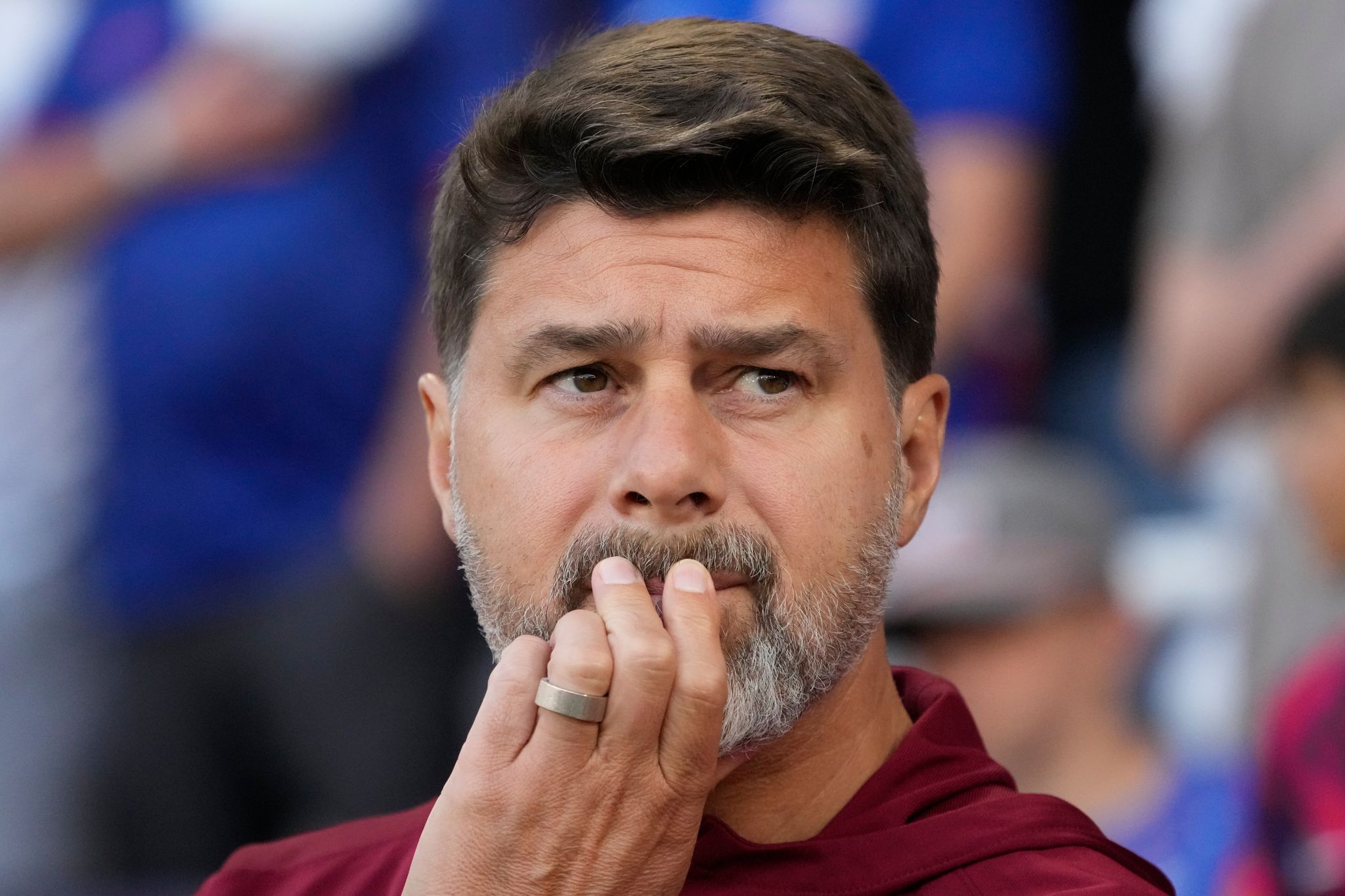

United States head coach Mauricio Pochettino’s roster for World Cup reflects his background and desire for ‘wolves.’
Mauricio Pochettino was born 54 years ago in Murphy. But he didn’t grow up with a baseball bat or an American football tucked under his arm. Nor did he go to watch the games of the Texas Rangers or the Dallas Cowboys. Instead, he grew up playing “fútbol” —spelled with a “u”, not a double “o”.
Pochettino’s Murphy is not the suburban town located northwest of Dallas. His Murphy lies further south. Quite a bit further south, in fact. It is a small farming and ranching town of just over 3,500 inhabitants in the Argentine province of Santa Fe, situated about 90 miles southwest of the provincial capital, Rosario, and some 230 miles northwest of Buenos Aires—the capital of Argentina, his home country. It owes its name to an Irish immigrant who arrived in 1844 and became a powerful landowner.
Although English is spoken in one and Spanish in the other, the two Murphys share similar characteristics. Yet in Pochettino’s footballing lexicon, they could not be more different—as different, in fact, as baseball or American football are from fútbol.
Article continues below this ad
Goalkeepers: Chris Brady (Chicago Fire FC, MLS), Matt Freese (New York City FC, MLS), and Matt Turner (New England Revolution, MLS). Defenders: Max Arfsten (Columbus Crew, MLS), Sergiño Dest (PSV Eindhoven, Netherlands), Alex Freeman (Villarreal, Spain), Mark McKenzie (Toulouse, France), Tim Ream (Charlotte FC, MLS), Chris Richards (Crystal Palace, England), Antonee Robinson (Fulham, England), Miles Robinson (FC Cincinnati, MLS), Joe Scally (Borussia Mönchengladbach, Germany), and Auston Trusty (Celtic, Scotland).
Midfielders: Tyler Adams (Bournemouth, England), Sebastian Berhalter (Vancouver Whitecaps FC, MLS), Weston McKennie (Juventus, Italy), Gio Reyna (Borussia Mönchengladbach, Germany), Cristian Roldan (Seattle Sounders FC, MLS), and Malik Tillman (Bayer Leverkusen, Germany).
Forwards: Brenden Aaronson (Leeds, England), Folarin Balogun (Monaco, France), Ricardo Pepi (PSV Eindhoven, Netherlands), Christian Pulisic (AC Milan, Italy), Tim Weah (Olympique Marseille, France), Haji Wright (Coventry, England), and Alejandro Zendejas (Club América, Mexico).
After losing the Gold Cup final in Houston to Mexico last summer, the current head coach of the United States national team alluded to the lack of a soccer “culture” that, in his view, exists in this country. That very “culture” which the United States obviously possesses in abundance when it comes to both baseball and American football. He stated that, for him, instilling this culture in his players was a key objective in his role as head coach, particularly with the World Cup — hosted this summer by the United States, Mexico, and Canada — looming on the horizon.
It was a press conference charged with palpable tension. Pochettino was visibly annoyed. It was partly due to the adverse result against their regional CONCACAF rival — against whom they practically appeared to be playing as the away team in their own NRG Stadium packed with Mexican fans — and perhaps partly, though he didn’t say so explicitly, due to the criticism he had been receiving from certain quarters, particularly from former players and coaches of the U.S. national team, ever since he was announced as head coach in Sept. 2024.
Under the influence of ‘El Loco’
Pochettino began kicking a ball as a child at the Club Centro Recreativo Unión y Cultura in Murphy, and later honed his skills under the guidance of one of Argentine football’s greatest talent scouts: Jorge Griffa. He grew up under Griffa’s tutelage in the youth divisions of Newell’s Old Boys—the Rosario-based club that produced world-class stars such as Lionel Messi and Gabriel Batistuta, among many others.
Article continues below this ad
He made his first division senior team debut for his beloved “Ñuls” in 1988 under the management of José Yudica, and later established himself as a key player under the then-young head coach Marcelo Bielsa. Nicknamed “El Loco” (The Madman) for his passion and obsession with soccer, Bielsa was a tactical innovator for his time — even more so within the context of Argentine football, which remained deeply divided between the contrasti’ng styles of the two coaches who had led the country to its first two World Cup titles (won in 1978 and 1986, respectively): César Luis Menotti and Carlos Salvador Bilardo. Broadly speaking, the “Menottistas” rallied on one side praising an attacking style of play, while the “Bilardistas” made a cult of defense among other stylistic and philosophical differences.
But Bielsa hoisted his own banner. And he didn’t do too badly. With Pochettino among his players, that Newell’s team was crowned champions of Argentina and subsequently reached the final of the 1992 Copa Libertadores in South America where they ultimately fell to the powerful São Paulo side managed by the highly respected Brazilian coach Telê Santana.
Eventually, his successes catapulted him to the Argentine national team — a squad for which he also called up Pochettino as a defender, alongside other standout figures from that brilliant Newell’s side, including former Mexico head coach Gerardo ‘Tata’ Martino, who is currently in his second spell with Atlanta United after taking them to the Mayor League Soccer (MLS) title in his first spell in the United States. Bielsa cruised through the South American qualifiers for the 2002 FIFA World Cup in Japan and South Korea, putting on a masterclass in football and, along the way, outperforming the mighty Brazilian national team—the very squad that would later go on to claim the title at that tournament in Asia.
Some of the keys to his style of play were simpler than many imagined: intensity, a high press, and a concerted effort to stifle the opponent through tight marking, forcing them to either lose possession or play a contested ball. Once his team had the ball, the objective was to cherish it — never to “give it away cheaply” — and to work it up the pitch toward the opposing goal through fluid circulation. In essence, this is precisely what is seen to varying degrees in modern football today.
Article continues below this ad
At a different pace, of course for times change, Pochettino has adapted these concepts throughout his managerial career: from his early days with Espanyol in Barcelona, to his tenure at Southampton in England which catapulted him to his brilliant Tottenham Hotspur, and subsequently to PSG in France and Chelsea in London, before ultimately taking up his current post in the United States.
“The style of play at Newell’s bore many parallels to that of Tottenham: it was intense, played at maximum speed, featuring a high press and many mechanized movements; we sought to physically dominate our opponents, playing to suffocate them and make them uncomfortable whenever we didn’t have the ball. And Bielsa needed every one of us to believe in him for it to work,” explained Pochettino in the book “Un nuevo mundo” (A New World) by Spanish journalist and writer Guillem Balagué. “The starting eleven was full of players who had to shoulder their own responsibilities; we weren’t just soldiers—we were part of the decision-making process. From my position as a left-sided center-back, I grew alongside Bielsa’s bold and courageous game plan, which dared to challenge the conventional wisdom of the era.”
Pochettino’s primary objective — both back then in England and now, in this new chapter of his coaching career in the United States — is to instill that winning mentality in his players: to get them accustomed to playing under the imperative to win every single match. It is a key component of the ‘footballing culture’ that he believes has yet to be fully embraced here.
Learning from experience
That Argentine national team under Bielsa—a manager who is currently preparing to compete in the World Cup once again, this time at the helm of Uruguay—arrived at the 2002 tournament as a heavy favorite to win the title, yet was eliminated in the first round. It was a complete failure: since their last absence from the World Cup (Mexico ’70), that remains the only edition to date in which ‘La Albiceleste’ (White and Light Blue) failed to advance past the first round.
Article continues below this ad
What went wrong? Bielsa, an idealist, placed his blind faith in the very style that had previously brought him success. However, his opponents had studied his tactics down to the minutest detail. Bielsa—and, by extension, Argentina—remained steadfastly loyal to their principles, only to be eliminated by a narrow margin in the group standings. That team was either unable—or simply didn’t know how—to implement a “Plan B” in case things didn’t go according to plan.
Curiously, of the 22 matches Pochettino has overseen at the helm of the U.S. national team (yielding 13 wins, two draws, and seven losses), the standout performance was the 5–1 thrashing he handed to Bielsa’s Uruguay squad in a friendly played on Nov. 18 in Tampa, Fla. On that day, the student defeated the master.
That, precisely, will be the key to Pochettino’s success with the U.S. squad. Unlike the Bielsa of that era — specifically, the one who presided over Argentina’s disastrous 2002 World Cup campaign — Pochettino must know when to turn to pragmatism whenever a specific tactic or game plan fails to yield the expected results.
To achieve this, he requires players with a hunger and thirst for victory — as he has stated on numerous occasions — players capable of pushing themselves to the absolute limit, doubling up in their defensive marking to win back possession, and then utilizing the ball to maximum effect in the attack.
“A dog and a wolf are essentially the same thing, save for one difference: the dog lives in a house, has food and water provided, and sleeps in its owner’s bed. The wolf, on the other hand, lives in the mountains; it must hunt for its own food and find its own shelter. On my team, I want wolves —people with hunger and ambition,” recounted Pochettino, who once shared this very message via WhatsApp with his Tottenham players, as revealed in Guillem Balagué’s biography.
Article continues below this ad
But then comes the hardest part: knowing what to do with the ball once possession is secured. The creative aspect, as is well known, has never been a strong suit for U.S. national teams. Tactics can be applied, physical conditioning can be honed to perfection, and commitment can be absolute; yet, even with all those elements in place, it is sometimes simply not enough. That is why sheer talent is so indispensable in making the difference. Among the players he called up for the World Cup last Tuesday, Pochettino selected an attacker like Alejandro Zendejas — a choice that could inject a dose of audacity into the offense — yet this decision also meant leaving out the talented Diego Luna, who had largely provided the creative spark necessary to reach the Gold Cup final a year ago.
During the press conference in which he officially announced the World Cup squad, Pochettino chose not to dwell on those left out. He stated that he fully understood what must be going through their minds, having himself been left off Argentina’s rosters for the 1994 and 1998 World Cups before finally realizing his dream of playing in the tournament in 2002. However, he did answer questions regarding the players he did select; among them, he specifically mentioned Zendejas—who grew up in Texas, came up through the youth ranks at FC Dallas before making his Major League Soccer (MLS) debut in 2015, and now shines in the attack for Club América in Liga MX.
The goalkeeping —featuring three keepers who play for Major League Soccer (MLS) clubs—appears to be the weakest link in the team’s structure, and there does not seem to be a designated starter heading into the final warm-up friendlies: against Senegal on May 31 in Charlotte and against Germany on June 6 in Chicago. The anchor of the defense will almost certainly be Chris Richards, who is coming off a strong season in the English Premier League with Crystal Palace—the newly crowned champions of the European Conference League. In the midfield, the team will likely rely heavily on the quality and experience of Weston McKennie, a standout player for Juventus in Italy.
It is in the attack, however, where the team possesses its greatest wealth of quality options, with Folarin Balogun — a speedy forward currently in top form at Monaco in France — and captain Christian Pulisic of AC Milan standing out as the key figures. In fact, Zendejas himself, or El Paso native Ricardo Pepi, could play supporting roles after also being named to the final roster — that select group that Pochettino hopes will transform into his ‘pack of wolves’ during the World Cup.
California native Luna—who, after playing a pivotal role in 2025, lost ground after missing the March friendlies due to a knee injury—will be on stand-by alongside another midfielder who was surprisingly left out of the main squad: Tanner Tessmann of Olympique Lyonnais in France. They will be waiting like others also included in the provisional squad of 55 players. Another significant absence will be that of midfielder Johnny Cardoso, who suffered a severe right ankle injury during a training session with Atlético Madrid in Spain.
Germán Fernández-Moores is the editor of La Voz de Houston, the Spanish-language weekly of the Houston Chronicle. You can reach him at German.Fernandez-Moores@houstonchronicle.com