

Benin’s Romuald Wadagni Sworn In, Pledges Continuity and Inclusive Growth
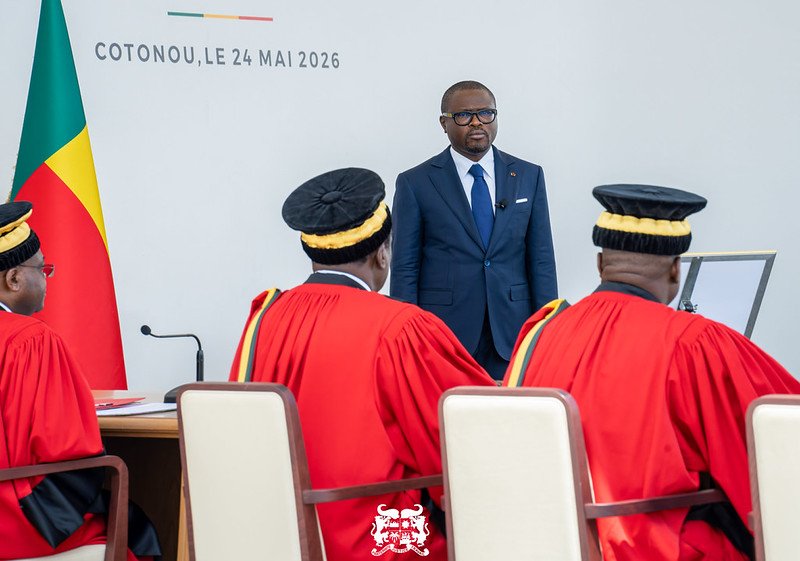
COTONOU, Benin
Romuald Wadagni was officially sworn in as president of Benin on Sunday, promising to deepen economic reforms, strengthen social development and preserve regional stability after a landslide victory in the April 12 presidential election that reflected broad support for policy continuity and economic transformation.
In his inaugural address, Wadagni described the moment as more than “the choice of a man,” calling it a choice of “direction, method and shared ambition” for the West African nation.
The former finance minister, who won 94 percent of the April 12 vote, praised outgoing President Patrice Talon for leading what he called Benin’s “renaissance” through difficult but necessary reforms.
He said Talon’s leadership restored national confidence and helped put Benin back on a path toward development.
Wadagni said growth only matters when young people can find opportunities at home, mothers can afford health care and farmers can bring products to market because roads and infrastructure function effectively.
He pledged expanded access to financing and social protections for women, increased mechanization and support for farmers, and stronger engagement with Benin’s diaspora.
The president also reaffirmed Benin’s role as a symbolic “homecoming” destination for descendants of Africans displaced by the trans-Atlantic slave trade.
On security, Wadagni acknowledged growing terrorist threats across West Africa but vowed Benin “will neither yield to fear nor complacency.”
He promised continued investment in defense forces alongside economic development and social services aimed at strengthening national cohesion.
The new president also emphasized regional cooperation, saying African nations must work together against insecurity while building “a powerful Africa” capable of making and executing its own strategic choices.
Closing his speech, Wadagni pledged to govern “with integrity, courage and constancy,” insisting that political power is “a responsibility before the people and before history.”
From Lokossa to the presidency
Wadagni’s rise to the presidency mirrors Benin’s broader economic transformation over the past decade.
He was born June 20, 1976, in Lokossa, the eldest of five children in a family that emphasized education and public service.
He graduated at the top of his class from the École Supérieure des Affaires in Grenoble, qualified as a chartered accountant in both France and the United States, and completed a program at Harvard Business School.
He spent 17 years at Deloitte across offices in Paris, New York and Kinshasa before his appointment as finance minister in April 2016.
In government, he negotiated a $700 million agreement with the International Monetary Fund in 2022 and, in January 2025, secured $500 million in international bonds at rates below initial guidance, backed by $3.5 billion in investor demand.
The vision behind the transformation
When Patrice Talon came to power in April 2016, Benin faced erratic growth, high public deficits, rising debt levels and a challenging business climate, with the economy heavily dependent on cotton and trade with Nigeria.
Talon, a businessman who built his fortune in the cotton industry before entering politics, pursued a reform agenda focused on fiscal discipline and economic diversification.
Two successive Government Action Programs, including a 9-trillion CFA franc investment package from 2016 to 2021 and a 12-trillion CFA franc program for 2021-2026, directed major investments toward infrastructure, agricultural diversification and social services.
GDP growth rose from 3.3% in 2016 to 7.5% in 2024, and both S&P and Fitch upgraded Benin’s credit rating in 2024.
The Glo-Djigbé Special Economic Zone, launched in 2021, generated more than 14,000 jobs and attracted investors from Asia, Europe and the Middle East.
Talon leaves office after respecting the two-term constitutional limit, reinforcing the credibility of Sunday’s transition, while Wadagni begins a seven-year mandate under reforms adopted in 2025.
Credit: Source link